



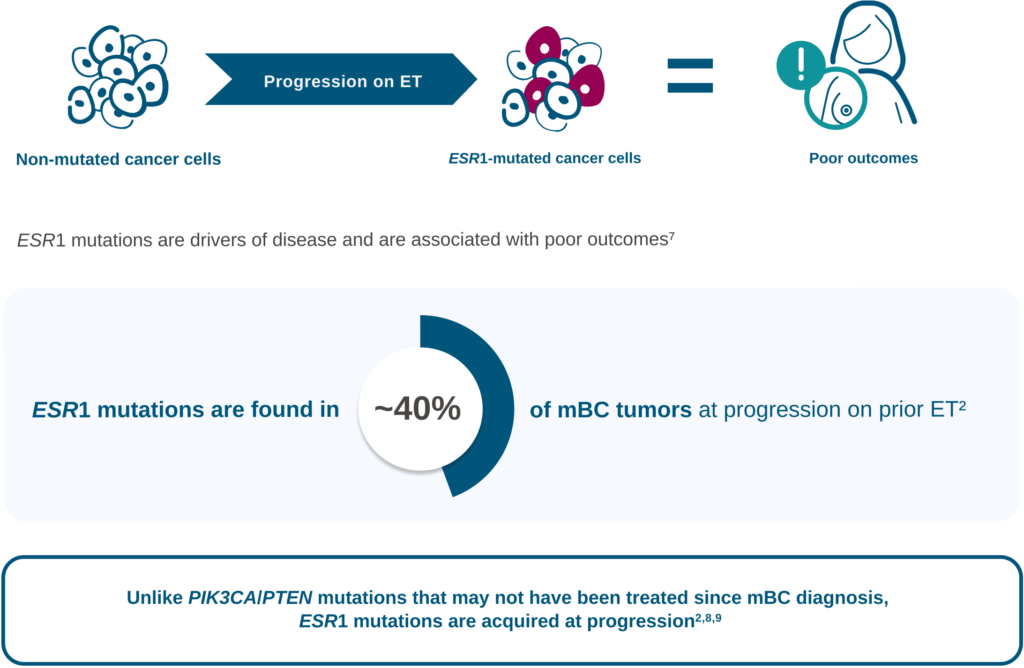
ESR1 mutations…
…are more likely to develop after prolonged exposure to prior ET
ESR1 mutations are present in ~40% of cases after long-term prior ET.1,2

…are rarely found in the primary tumour
ESR1 mutations are acquired during ET and are unlikely to be detected in primary tumours.1
…testing is recommended at each progression on ET…should be tested for at each progression on ET (if not previously detected)
A tumour previously negative for an ESR1 mutation can still develop an ESR1 mutation after ET.3-6
…are more likely to develop after prolonged exposure to prior ET
ESR1 mutations are present in up to 40% after long-term prior ET.1,2
…are rarely found in the primary tumour
ESR1 mutations are acquired during ET and are unlikely to be detected in primary tumours.3
…testing is recommended at each progression on ET…should be tested for at each progression on ET (if not previously detected)
A tumour previously negative for an ESR1 mutation can still develop an ESR1 mutation after ET.4-7
mBC tumors acquire ESR1 mutations directly under pressure from prior ET, primary AI1
Longer exposure to ET increases the chance of developing ESR1 mutations1,2,6,8-14
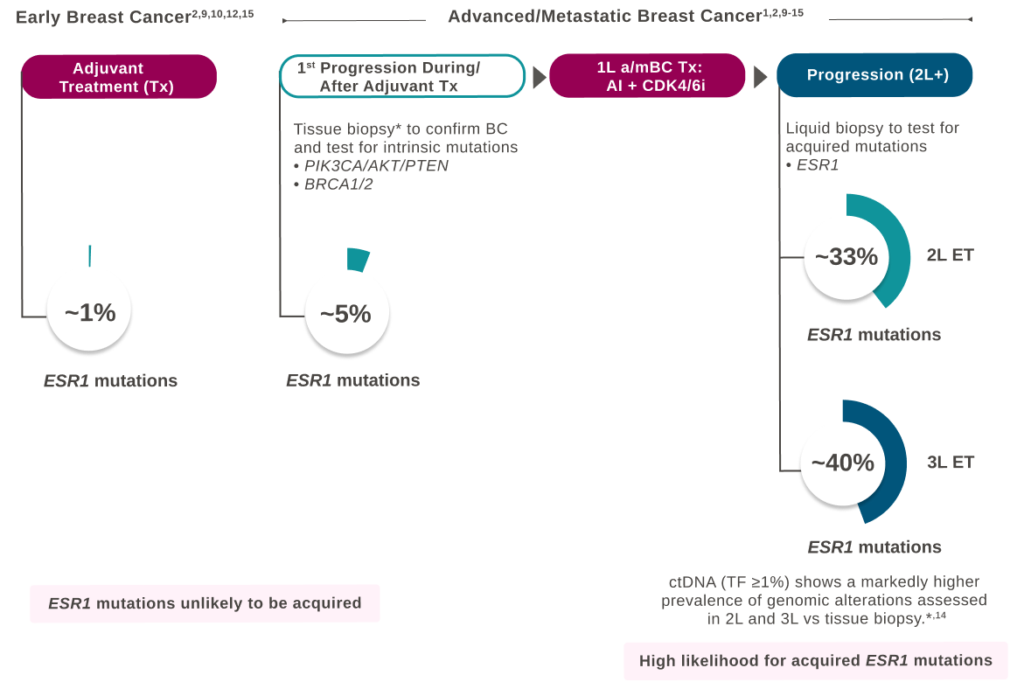
*Fresh tissue biposy testing is not reumbursed in the UK.
ESR1 mutations are rarely found in the primary tumour
ESR1 mutations are rare and acquired, and not present in primary tumours; testing of primary tumours will likely not detect the acquired mutations that occur after treatment on endocrine therapy (ET).1


Test at each progression for ESR1 mutations if not detected previously4,6
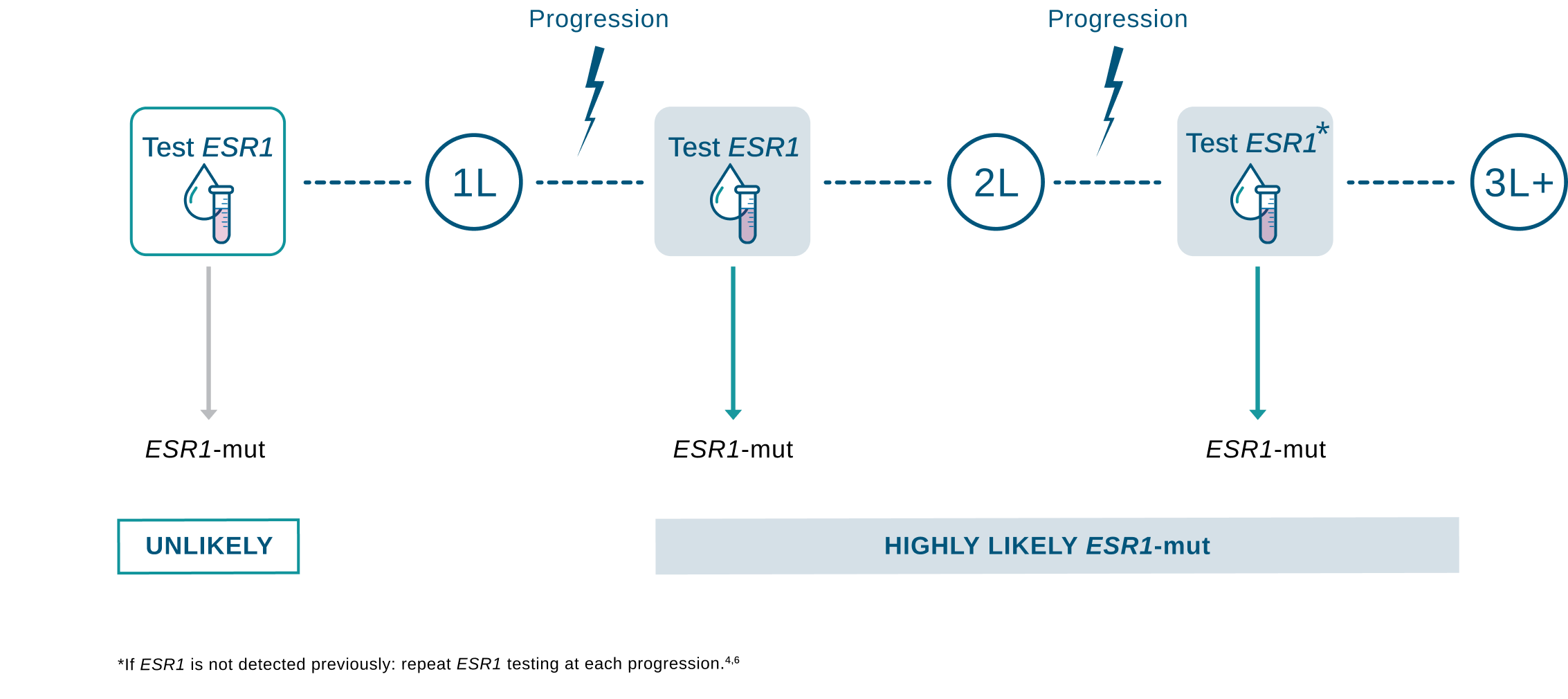
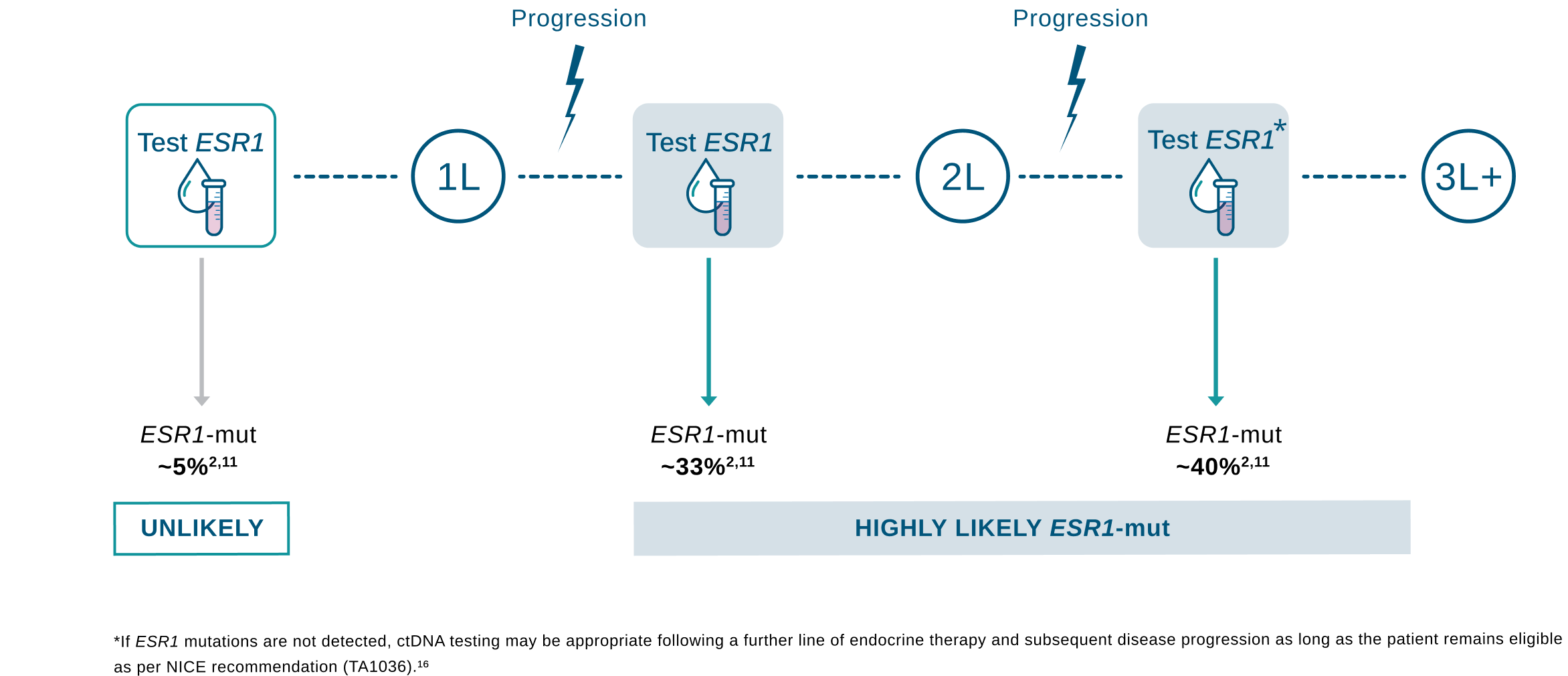
Decision Tree
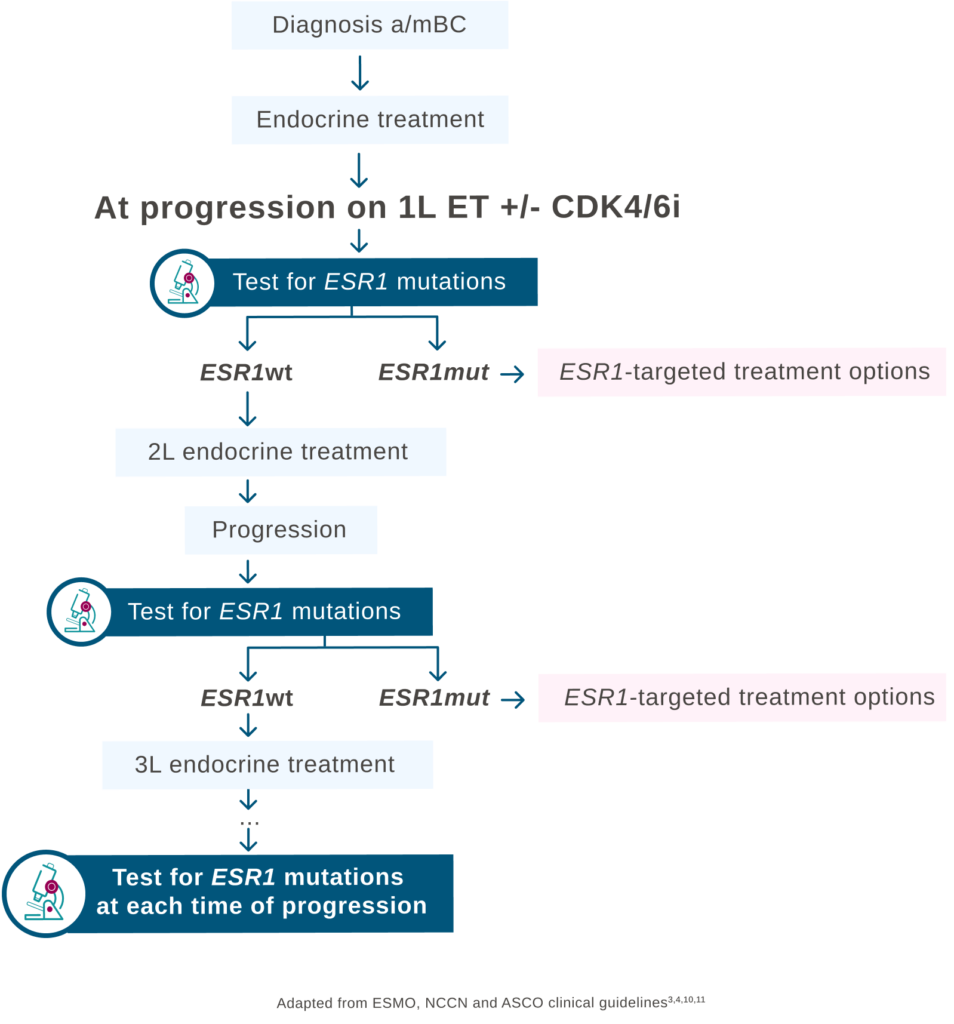
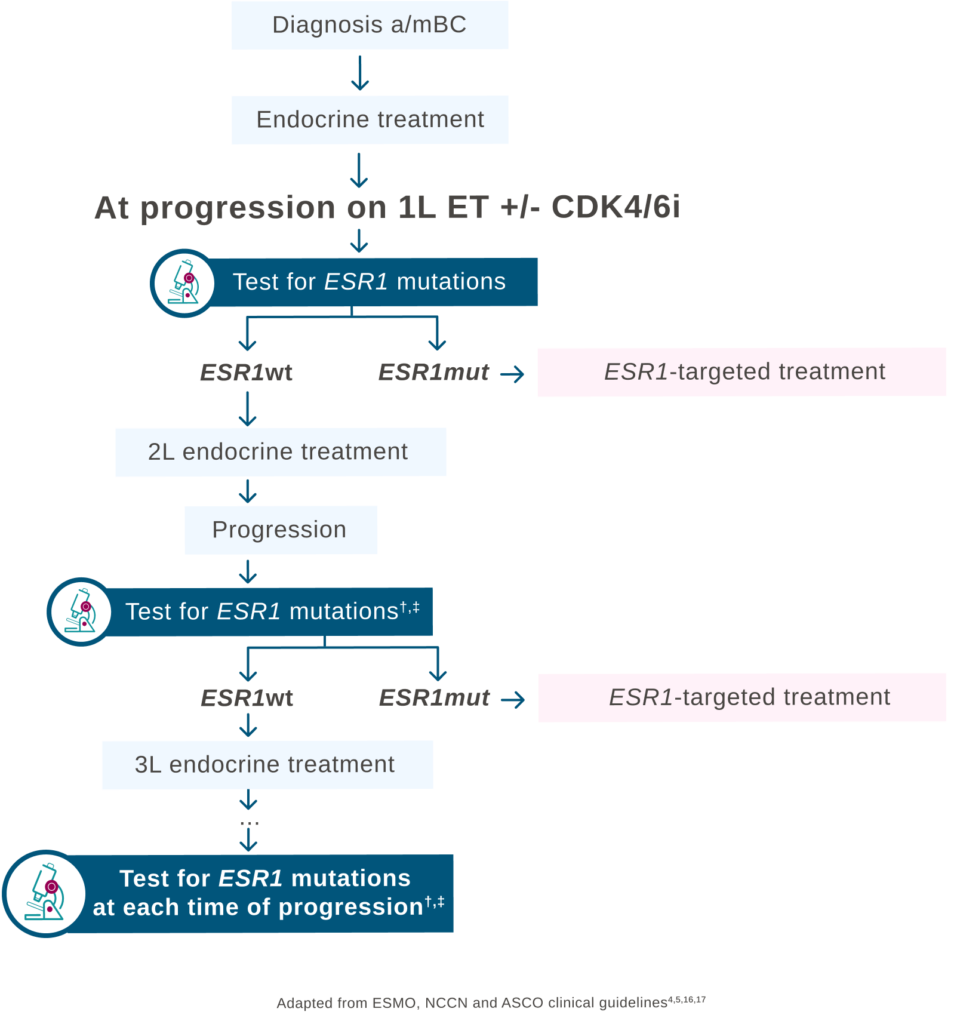
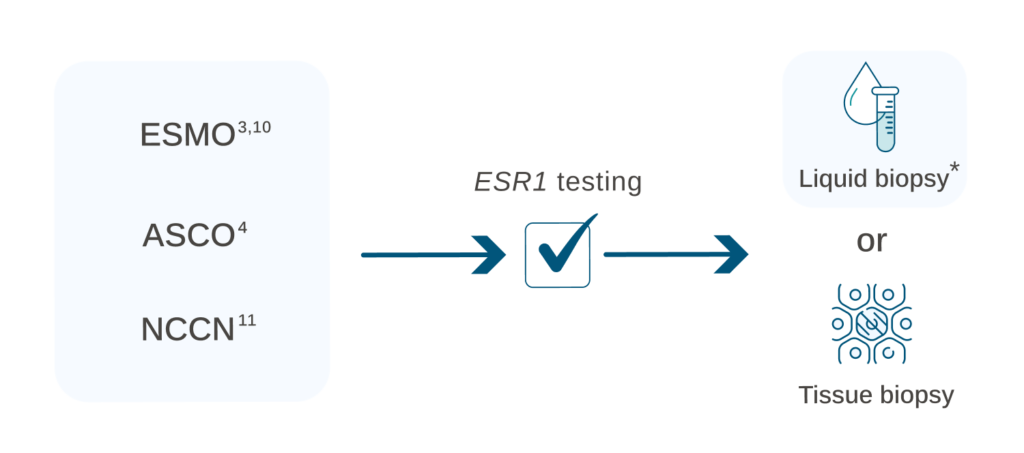
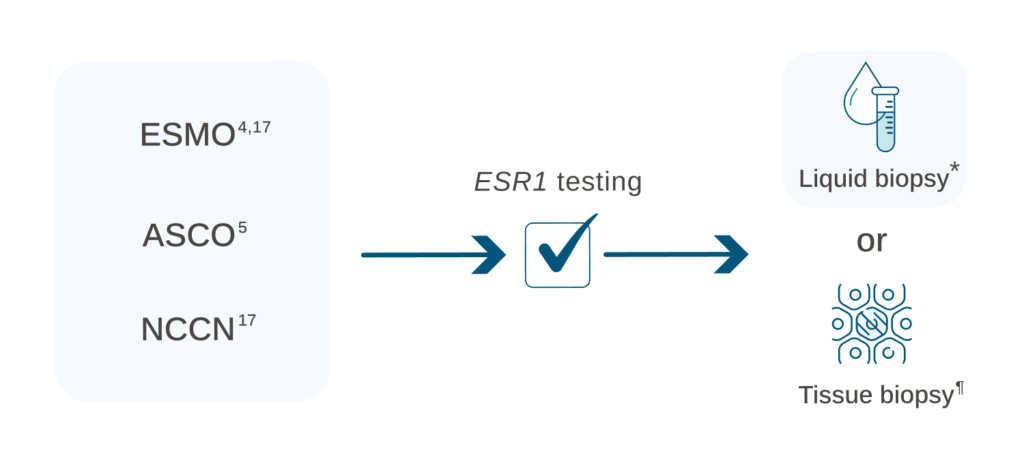
National and international guidelines such as the European Society for Medical Oncology (ESMO),3,17 National Comprehensive Cancer Network® (NCCN®),18 and American Society for Clinical Oncology (ASCO)4 recommend testing for ESR1 mutations in a/mBC using either liquid biopsy¶ or tissue biopsy at time of disease progression.§
When to consider retesting for ESR1 mutations
A tumour previously negative for an ESR1 mutation can still develop an ESR1 mutation after ET.3-6
For tumours or ctDNA tests which remain ESR1 wild-type, retesting may be warranted at subsequent progression(s) to determine whether an ESR1 mutation has developed (as long as patient remains eligible as per NICE recommendation TA1036).4,16,‡
*A ctDNA sample represents the tumour biology of all metastatic sites.6
†Repeat ctDNA testing may be appropriate following a further line of endocrine therapy and subsequent disease progression as long as the previous test was negative and patient remains eligible as per NICE recommendation (TA1036).16
‡Re-testing may be indicated if previous results were non-informative (e.g., low circulating tumour fraction) or if the sample failed technical quality checks.
§Following prior line of endocrine therapy.18
¶Tissue biopsy testing is not reimbursed in the UK.
1L: first-line; 2L: second-line; 3L: third-line; AI: aromatase inhibitor; a/mBC: advanced/metastatic breast cancer; ASCO: American Society for Clinical Oncology; CDK4/6i: cyclin dependent kinase 4/6-inhibitor; ctDNA: circulating tumour DNA; ESR1: oestrogen receptor 1; ESMO: European Society of Medical Oncology; ET: endocrine therapy; mBC: metastatic breast cancer; mut: mutation; NCCN: National Comprehensive Cancer Network; PIK3CA: phosphatidylinositol-4,5-bisphosphate 3-kinase catalytic subunit alpha; PTEN: Phosphatase and TENsin homolog; Tx: treatment; WT: wild type.
- Dustin D, et al. Cancer. 2019;125(21):3714–28.
- Brett JO, et al. Breast Cancer Res. 2021;23(1):85
- ESMO Metastatic Breast Cancer Living Guideline, v1.2 April 2025. Accessed March 2026. Available at: https://www.esmo.org/guidelines/living-guidelines/esmo-living-guideline-metastatic-breast-cancer.
- Burstein HJ, et al. J Clin Oncol. 2023;41(18):3423–5.
- Lee N, et al. Int J Mol Sci. 2020;21(22):8807.
- Russano M, et al. J Exp Clin Cancer Res. 2020;39(1):95.
- Zhang K, et al. Cancer Manag Res. 2018;10:2573-2580.
- Arthur LM, et al. Breast Cancer Res Treat. 2014;147(1):211-219.
- Turner NC, et al. N Engl J Med. 2023;388(22):2058-2070.
- Gennari A, et al. Ann Oncol. 2021;32(12):1475–95.
- Referenced with permission from the NCCN Clinical Practice Guidelines in Oncology (NCCN Guidelines®) for Breast Cancer Version 1.2026. ©National Comprehensive Cancer Network, Inc. 2026. All right reserved. Accessed March 2026. To view the most recent and complete version of the guideline, visit NCCN.org. NCCN makes no warranties of any kind whatsoever regarding their content, use or application and disclaims any responsibility for their application or use in any way.
- Bidard FC, et al. J Clin Oncol. 2022;40(28):3246–56.
- Allouchery V, et al. Breast Cancer Research. 2018;20(1):40.
- Dustin D, et al. Cancer. 2019;125(21):3714–28.
- ESMO Metastatic Breast Cancer Living Guideline. HR-positive, HER2-negative metastatic breast cancer. Accessed 11 March 2026. https://www.esmo.org/living-guidelines/esmo-metastatic-breast-cancerliving-guideline/hr-positive-her2-negative-metastatic-breast-cancer/hr-positive-her2-negative-metastatic-breast-cancer.
- Burstein HJ, et al. J Clin Oncol. 2023;41(18):3423–5.
- Lee N, et al. Int J Mol Sci. 2020;21(22):8807.
- Russano M, et al. J Exp Clin Cancer Res. 2020;39(1):95.
- Jeselsohn R, et al. Nat Rev Clin Oncol. 2015;12(10):753–83.
- Schiavon G, et al. Sci Transl Med. 2015;7(313):313ra182.
- Toy W, et al. Nat Genet. 2013;45(12):1439–45.
- Brett JO, et al. Breast Cancer Res. 2021;23(1):85
- Jhaveri K, et al. Ann Oncol. 2023;34(suppl_2):S338–S339.
- Lin N, et al. Ann Oncol. 2023;34(suppl_2):S338.
- Bhave MA, et al. Breast Cancer Res Treat. 2024;207(3):599–609.
- Jeselsohn R, et al. Clinical Cancer Research. 2014;20(7):1757–67.
- NICE. Technology appraisal guidance TA1036. 5 May 2026. Available at: https://www.nice.org.uk/guidance/ta1036.
- Gennari A, et al. Ann Oncol. 2021;32(12):1475–95.
- Referenced with permission from the NCCN Clinical Practice Guidelines in Oncology (NCCN Guidelines®) for Breast Cancer Version 4.2026. ©National Comprehensive Cancer Network, Inc. 2026. All right reserved. Accessed May 2026. To view the most recent and complete version of the guideline, visit NCCN.org. NCCN makes no warranties of any kind whatsoever regarding their content, use or application and disclaims any responsibility for their application or use in any way.